You’ve probably seen the number floating around: 10 mg a day for 10 days, maybe 5 to 10 mg daily, injected under the skin, done twice a year like clockwork. It gets repeated so often, on so many forums and vendor pages, that it starts to sound like settled science. Like somewhere there’s a proper trial that landed on that exact figure.
I went looking for that trial. Here’s the short version: it doesn’t exist. And once you understand why, you’ll never look at a “standard dose” chart the same way again.
Let’s untangle this properly, then get to what you can actually do with the information.
The confusion, cleared up
First, the basics. Epithalon (sometimes spelled epitalon) is a research-stage peptide. It is not an FDA-approved medication. Nothing here is a protocol for you to follow on your own; it’s a plain look at what the evidence does and doesn’t say.
Here’s the thing that tipped me off that something was wrong with the “standard dose” story: everybody quotes almost the exact same number. In fields where real dose-finding trials exist, you usually see a spread, because different studies land on different optimal amounts. When every single source repeats nearly the same figure, that’s usually a sign they’re all copying one original source rather than pulling from independent research.
So where did that original number come from? Not from a human dosing trial. It was pieced together from a scattered mix of cell-culture and animal studies that were never designed to answer “how much should a person inject.”
Look at the actual research and you’ll see why the leap doesn’t hold up:
- The 2003 study that gave epithalon its reputation looked at human fetal fibroblasts in a lab dish, exposed to certain concentrations in the culture medium, and found the peptide switched on telomerase and lengthened telomeres (PMID 12937682) [1]. A concentration in a petri dish just doesn’t convert into a milligram figure for a person. There’s no honest math that gets you from one to the other.
- A 2025 independent replication out of Brunel University London confirmed the telomere effect, but again, in cells, not people (PMID 40908429) [2]. Great for the underlying mechanism, no help with dosing.
- The fruit fly lifespan study added epitalon to the growth medium only during development, egg to larva, with effective amounts even differing by sex (PMID 11087911) [3]. That’s an insect’s developmental window, not a schedule for a grown adult.
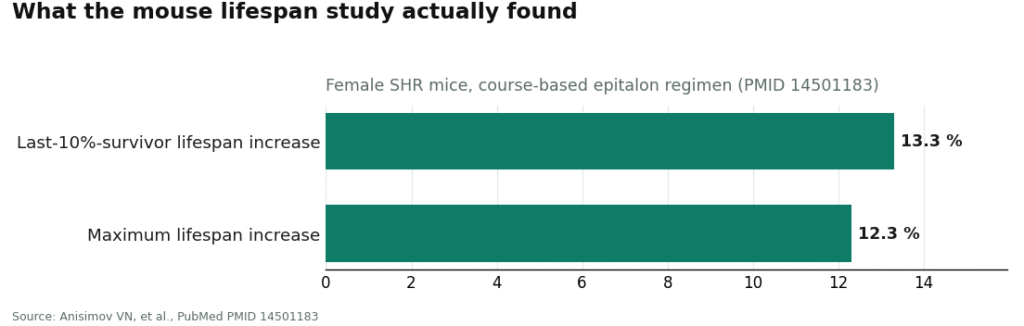
- The mouse study, done in female SHR mice on a course-based regimen, didn’t even increase average lifespan. It raised the lifespan of the longest-lived 10% of survivors by 13.3 percent and maximum lifespan by 12.3 percent, and it cut leukemia rates, but the average mouse didn’t live longer (PMID 14501183) [4].
So the “standard dose” is standard in one sense only: it gets copied a lot. It’s a habit dressed up as a guideline.
What the people who like this peptide are saying
I want to be fair here, so I didn’t just take my own suspicion as proof. A 2025 review in the International Journal of Molecular Sciences, written by researchers clearly interested in epithalon rather than trying to debunk it, says the quiet part out loud. The exact mechanism of action is still unverified. It’s unclear whether the proposed pathways are the only ones involved. And studies on short- and long-term toxicity, genotoxicity, and cancer risk are described as essential and still needed (PMC11943447) [5].
Translate that into plain terms: the safety homework that should sit underneath any dose recommendation hasn’t been done. You can’t have a well-founded “standard dose” without that groundwork, and the groundwork is missing.
There’s also a structural wrinkle worth knowing. Most of the human and lifespan research on this peptide traces back to one research program, led by Vladimir Khavinson at the St. Petersburg Institute of Bioregulation and Gerontology in Russia. The Wikipedia overview of epitalon flags this directly, noting the topic leans heavily on primary sources from that single institute, with independent replication only recently beginning (Wikipedia, Epitalon) [6]. When a “standard” traces back to one lab’s choices rather than a field of converging trials, calling it standard oversells it.
See also: NextGen IT Platform Network
The checklist: what a dosing chart never tells you
Here’s what really bugged me. Every dosing chart answers “how much, how often.” None of them answer the questions that actually decide whether a dose makes sense for you. Before you’d ever trust a number like this, you’d want to know:
- Does it interact with anything else you take? A chart has no idea what’s in your medicine cabinet.
- Is what’s in the vial actually what the label says? A research-chemical vial comes with a disclaimer, not a guarantee.
- Is this schedule appropriate for your health history? A chart can’t ask you a single question.
- Who’s watching for problems if something goes wrong? With a copied number and an unverified vial, usually nobody.
A dose only means something in the context of an actual person taking it, verified against what’s actually in the container. Strip out both of those things and what you’re left with isn’t really a dose. It’s a rumor with a decimal point attached.
The choice: two very different ways to get this peptide
If you’re going to consider epithalon at all, it really comes down to two paths, and they are not the same thing wearing different labels.
Path one, the gray market. A website ships you a vial marked “for research use only, not for human consumption.” You apply the copied number yourself. Nobody has screened you, nobody has verified what’s actually in the vial through any regulated process, and nobody is accountable if either the dose or the contents turn out to be wrong.
Path two, supervised medical access. A clinician reviews your health and current medications, decides whether epithalon makes sense for you at all, writes a prescription if it does, and a licensed compounding pharmacy prepares and dispenses it with follow-up care. FormBlends is one example of this route: the same peptide the gray market mails without oversight comes with an actual clinician and a licensed pharmacy involved, so the number applied to you exists in the context of a real evaluation and a known product, not a forum post and a guess.
To be clear about what this does and doesn’t fix: having a clinician choose your dose doesn’t suddenly make epithalon a proven therapy. The underlying evidence is exactly as thin as everything above describes. What changes is who’s choosing the number and what you actually know about what’s in the vial.
One more thing worth doing regardless of path: keep a record. If you’re working with a clinician, logging each dose and anything you notice afterward, in something like the FormBlends tracker app, means your next check-in is based on an actual record instead of a fuzzy memory. That app is a logging tool, nothing more, not a prescription and not a checkout. It’s the kind of follow-up the copy-the-number approach simply can’t offer, since that approach ends the moment your vial arrives.
Where this leaves you
I went looking for the study behind the “standard” epithalon dose and it isn’t there. What exists instead is a widely copied convention that traces back to one research tradition and a handful of cell and animal experiments whose numbers were never meant to become a human injection schedule. Even the researchers who are fans of this peptide say the basic toxicity work hasn’t been done yet, and that’s precisely the work a real dosing guideline needs underneath it.
So if you’re asking what dose the research actually supports, here’s the honest answer: it supports an interesting mechanism in a lab dish, and it does not support any validated human dose. If you’re going to move forward anyway, the only version of “dose” worth trusting is one picked by a clinician who knows your situation, made from a product that came through a licensed pharmacy, and written down so you can actually learn something from it. Everything else is just a number wearing a costume.
Questions people ask me about this
Is there an official “standard” epithalon dose? No. The schedules you see everywhere, like 10 mg a day for 10 days or 5 to 10 mg daily, don’t come from a modern dose-ranging trial in people, because that trial doesn’t exist for this peptide [5]. It’s a repeated convention, not a number a researcher worked out for humans.
Where did the popular “10 mg for 10 days” figure come from, then? It was pieced together from cell-culture and animal studies rather than pulled from one human protocol. The whole reputation rests on a 2003 dish study using human fetal fibroblasts and lab concentrations [1], and there’s no clean way to turn a concentration in a flask into a daily injection amount for a person. The animal studies used developmental or course-based setups in flies and mice [3][4], none of which map onto an adult human schedule.
Why does everyone quote nearly the same dose, then? Because they’re mostly copying the same source, not running independent numbers. Genuine dose-finding research usually produces a spread of recommendations. Nearly all of the epithalon and epithalamin literature traces back to one research program in St. Petersburg [6], so the “standard” reflects one group’s choices, not converging trials from many labs.
Has anyone actually studied whether these doses are safe? Not thoroughly. A 2025 review in the International Journal of Molecular Sciences says more work on short- and long-term toxicity, genotoxicity, and cancer risk is essential and still outstanding [5]. Without that, any confident milligram figure is resting on evidence that simply hasn’t been collected yet.
Is epithalon approved by the FDA? No. It’s a research-stage peptide, not an approved drug. It reaches people two ways: through the gray market, where an unsupervised vial arrives labeled “for research use only,” or through supervised compounding access, where a clinician and licensed pharmacy are both involved. FormBlends is one example of the supervised route.
What’s actually different between a gray-market vial and a supervised prescription? With a gray-market vial, you’re applying a copied number to a product nobody’s verified, with no one checking your medications first. With supervised access, a clinician evaluates you, decides if epithalon makes sense at all, and a licensed compounding pharmacy prepares it with follow-up. It’s the same peptide either way. What changes is whether the dose exists in the context of an actual patient and a checked product, or a forum thread and a guess.
What is epithalon, and where did it come from?
It’s a synthetic tetrapeptide, a chain of four amino acids, first developed by Russian researcher Vladimir Khavinson at the St. Petersburg Institute of Bioregulation and Gerontology. It’s a lab-made version of epithalamin, a peptide fraction originally isolated from the pineal gland. Most of the published research is in Russian journals, which makes independent double-checking harder than you’d want it to be.
What does it actually do in the body, based on research?
The most studied effect is telomerase activation, the process cells use to rebuild the protective caps on their chromosomes. Lab and animal work suggests epithalon may slow some markers of cellular aging through this route. Human data is thin, and no large randomized trials exist yet, so any firm claims about what it does inside a living person are premature. The biology is genuinely interesting. The clinical proof just isn’t there yet.
What side effects are known?
Published animal and small human studies haven’t flagged major adverse effects, but “nothing reported” isn’t the same as “confirmed safe.” Since epithalon isn’t approved in the US or EU, there’s no post-market system tracking real-world problems. Injection-site reactions are possible with any subcutaneous peptide. Getting it through a physician-supervised compounding pharmacy, like FormBlends, at least means quality-controlled product rather than an unknown powder from an unverified seller.
Is it legal to buy in the US?
It sits in a gray zone. It’s not FDA-approved as a drug, and the FDA has signaled that peptides like this can’t legally be sold as dietary supplements or compounded without genuine clinical justification. Buying it as a raw research chemical is technically legal in many states, but it puts you outside any regulatory protection. This picture can shift, so it’s genuinely worth checking current FDA guidance before you buy anything.
References
- Vinogradova IA, et al. Peptide regulation of telomerase activity and telomere length in human somatic cells. PubMed, PMID 12937682.
- Independent cell-line replication of epitalon telomere effects, Brunel University London, 2025. PubMed, PMID 40908429.
- Khavinson VKh, et al. Effect of epitalon on the lifespan of Drosophila melanogaster. PubMed, PMID 11087911.
- Anisimov VN, et al. Effect of epitalon on biomarkers of aging, lifespan and spontaneous tumor incidence in female SHR mice. PubMed, PMID 14501183.
- Epitalon: review of mechanisms, evidence gaps, and toxicity research needs. International Journal of Molecular Sciences, 2025. PMC11943447.
- Epitalon. Wikipedia overview noting reliance on primary sources from the St. Petersburg Institute of Bioregulation and Gerontology.
Written by Saskia Lindqvist, science writer. Last reviewed March 2026.
For general information only, not medical advice. Talk to a licensed clinician before starting anything new.